BRSR Reporting Requirements FY 2026-27: The Complete Checklist
Surbhi Ahuja
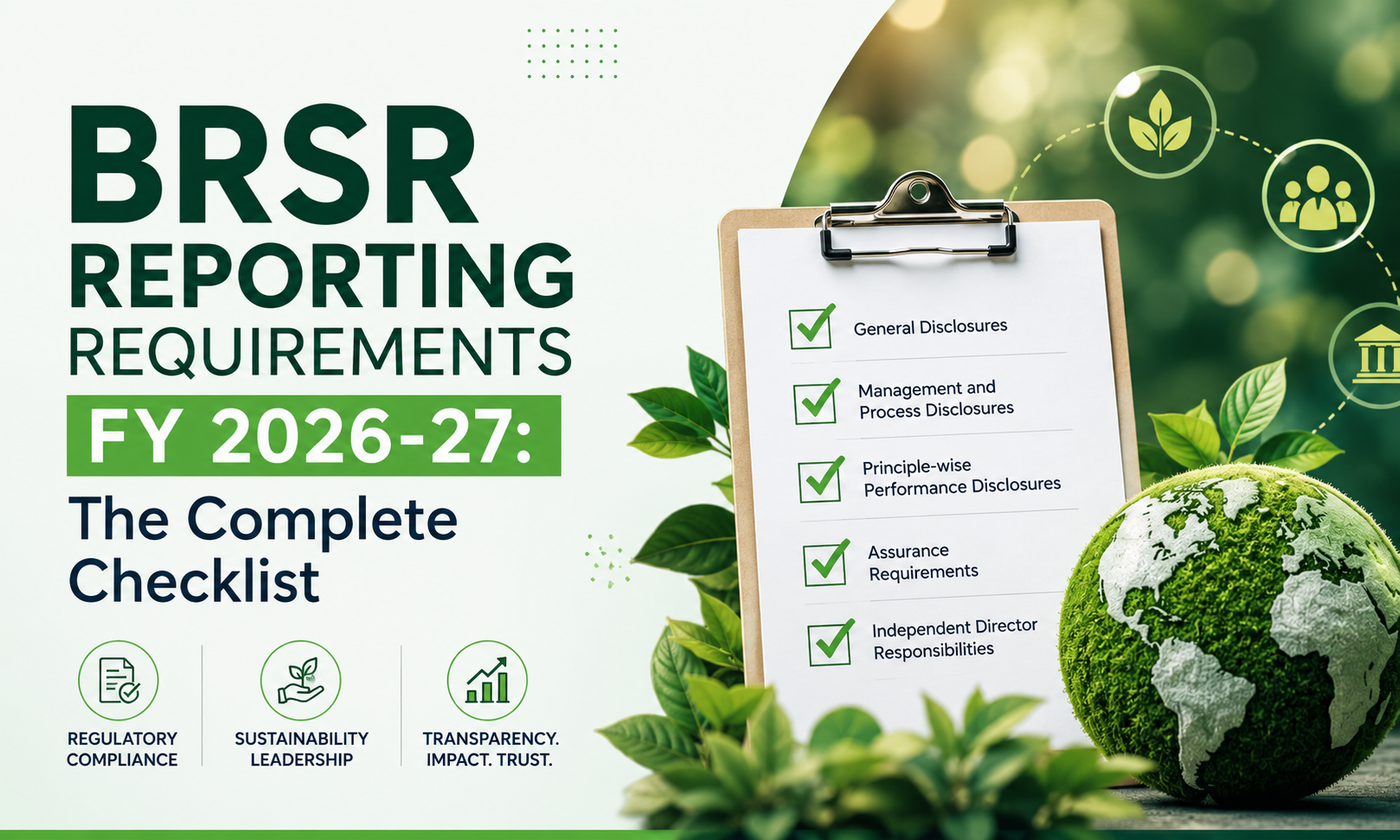
As India's corporate sustainability landscape matures, the BRSR reporting requirements 2026-27 have taken centre stage for compliance teams, CFOs, and ESG officers alike. The Business Responsibility and Sustainability Report (BRSR), mandated by SEBI, is no longer just a checkbox exercise. For FY 2026-27, it has evolved into a rigorous, data-driven disclosure framework that demands structured preparation well in advance of the filing deadline.
Whether you are a first-time filer or refining an existing ESG programme, this complete checklist will walk you through every critical element you need to address.
Why Does BRSR Matter in FY 2026-27?
The Business Responsibility Sustainability Report India is a standardised disclosure format introduced by SEBI to align Indian listed companies with global ESG frameworks such as GRI, TCFD, and the UN SDGs. It replaced the older Business Responsibility Report (BRR) and introduced a significantly more detailed set of indicators.
For ESG reporting India 2026-27, BRSR is the primary compliance vehicle. It evaluates companies across nine principles of the National Guidelines on Responsible Business Conduct (NGRBC), covering everything from environmental management and human rights to governance and stakeholder engagement.
Who Must File: BRSR Mandatory Companies
Understanding applicability is the first step in your 2026-27 BRSR checklist.
Mandatory Filing (Top 1,000 Listed Companies by Market Cap)
● The top 1,000 listed companies by market capitalisation (as per BSE/NSE) must mandatorily file the full BRSR.
● BRSR Core assurance follows SEBI's phased rollout: top 150 (FY 2023-24) → top 250 (FY 2024-25) → top 500 (FY 2025-26) → top 1,000 (FY 2026-27). FY 2026-27 completes the rollout of all top 1,000 companies, which must now obtain third-party assurance on BRSR Core KPIs.
● SEBI mandates reasonable assurance (a higher standard than limited assurance) for BRSR Core companies must engage accredited, independent assurance providers.
Voluntary Filing
● Listed companies outside the top 1,000 may voluntarily adopt the sustainability reporting framework in India to signal ESG maturity to investors and lenders.
📌 Tip: Verify your market-cap ranking at the start of Q1 FY 2026-27 to confirm applicability and plan resources accordingly.
The rise of BRSR mandatory companies' filing requirements signals that SEBI is steadily expanding the universe of obligated entities. Companies below the current threshold should treat voluntary compliance as a future-proofing exercise aligned with SEBI ESG disclosure requirements.
BRSR Structure: A Quick Overview
Before diving into the checklist, understand the three-part structure of the report:
Section A: General Disclosures - company profile, operations, subsidiaries
Section B: Management & Process Disclosures - policies, governance, targets
Section C: Principle-wise Performance Disclosures (9 Principles)
Section C is where the BRSR core indicators sit, the non-negotiable, quantitative KPIs that form the backbone of third-party assurance.
The Complete BRSR Checklist 2026-27
Use this BRSR checklist 2026-27 as your master preparation guide.
Section A: General Disclosures
● Update corporate identity details: CIN, registered address, website, stock exchanges
● Disclose number of employees and workers (permanent + contractual, male/female split)
● List all subsidiaries, associates, and JVs with BRSR applicability status
● Report turnover from products/services and key markets (domestic + export)
● Confirm participation in any industry associations or chambers
● Disclose CSR applicability and amount spent
These foundational data points anchor the entire Business Responsibility Sustainability Report India and must be verified against the latest annual data before filing.
Section B: Management & Process Disclosures
● Confirm board-level oversight policy for each of the 9 NGRBC principles
● Identify the highest governance body responsible for ESG/sustainability strategy
● Map all material ESG risks and link them to your enterprise risk management (ERM) framework
● Document stakeholder engagement processes (investors, employees, communities, regulators)
● Disclose whether BRSR is integrated into the Board's annual performance agenda
Strong management disclosures are a key signal to investors evaluating compliance with SEBI ESG disclosure requirements and governance quality.
Section C: Principle-wise Performance - BRSR Core Indicators
This is the heart of the BRSR reporting requirements 2026-27. Each principle maps to a business conduct theme:
Principle 1: Ethics & Transparency
● Number of complaints on bribery/corruption received and resolved
● Fines or penalties paid to regulatory authorities (amount + nature)
● Disclosure of conflict-of-interest policy
Principle 2: Sustainable Products & Processes
● R&D and capex spend on sustainable technologies (% of total)
● Life Cycle Assessment (LCA) status for top products
● Extended Producer Responsibility (EPR) compliance status explicitly required by SEBI's BRSR format: companies must disclose whether EPR is applicable and if their waste collection plan aligns with the EPR plan submitted to Pollution Control Boards
Principle 3: Employee Well-being (Key BRSR Core Indicators)
● Median wages (male/female, permanent/contractual)
● Employee benefit coverage rates: health, accident, maternity, paternity, day care
● Welfare measures for gig/contractual workers
● Attrition rate by gender and category
For the ESG reporting India 2026-27 cycle, SEBI has sharpened scrutiny on pay equity and contract worker welfare; ensure your HR team prepares structured data early.
Principle 4: Stakeholder Responsiveness
● Identify and map vulnerable/marginalised stakeholders
● Document grievance redressal mechanisms and response timelines
Principle 5: Human Rights
● Training coverage on human rights across the value chain (%)
● Assessment of suppliers/value chain partners on human rights parameters
● Number of human rights complaints received, pending, resolved
Principle 6: Environment (Heaviest BRSR Core Indicators Cluster)
● Scope 1, Scope 2, and Scope 3 GHG emissions (metric tonnes CO₂e)
● Energy consumption: total, renewable vs non-renewable (GJ)
● Water withdrawal, consumption, and discharge by source and quality
● Waste generated by type (hazardous/non-hazardous) and disposal method
● Air emissions: NOx, SOx, particulate matter
● Biodiversity impact assessment for sites near ecologically sensitive areas
Environmental KPIs are the most data-intensive element of the sustainability reporting framework. India assigned a dedicated environmental team and began monthly data collection in April 2026.
Principle 7: Policy Advocacy
● Disclose membership of trade bodies or industry associations
● Report positions taken on public policy issues in the public interest
Principle 8: Inclusive Growth
● Social Impact Assessments (SIAs) conducted
● Rehabilitation and resettlement (R&R) policy status
● CSR project outcomes linked to measurable community impact
Principle 9: Consumer Responsibility
● Customer complaints received and resolved (product safety, data privacy, unfair trade)
● Data privacy policy and cyber-security incident disclosure
● Product recall or safety notice history
BRSR Core: Third-Party Assurance Requirements
A critical and distinguishing feature of BRSR reporting requirements 2026-27 is mandatory third-party assurance for BRSR Core indicators. Crucially, FY 2026-27 marks the final phase of SEBI's phased rollout assurance is now mandatory for the entire top 1,000 listed companies, not just a subset.
SEBI's Phased Assurance Rollout -BRSR Core Assurance Mandatory For Entities
FY 2023–24: Top 150 listed entities by market capitalisation
FY 2024–25: Top 250 listed entities by market capitalisation
FY 2025–26: Top 500 listed entities by market capitalisation
FY 2026–27: Top 1,000 listed entities by market capitalisation (ALL)
This means FY 2026-27 is a watershed year for the first time, every company in the top 1,000 must obtain assurance on its BRSR Core KPIs. Companies ranked between 501 and 1,000 that have not yet prepared for assurance must begin immediately.
Assurance Readiness Checklist
● Engage a SEBI-recognised assurance provider (CA firm or specialist ESG assurer)
● Share internal data collection methodology with assurer in advance
● Resolve data gaps flagged in the previous year's assurance report
● Obtain a Reasonable Assurance opinion as required (SEBI mandates reasonable, not limited, assurance for BRSR Core)
● Include the assurance statement in the final BRSR submission
The BRSR core indicators subject to assurance primarily cover environmental metrics (GHG emissions, energy, water, waste), employee welfare (median wages, benefit coverage), and governance KPIs, all of which must be supported by verifiable, system-generated data rather than estimates.
BRSR Filing Deadline FY 2026-27 (Approx. Timeline)
The BRSR filing deadline for FY 2026-27 is tied to the Annual Report, which must be submitted to stock exchanges before the AGM. For companies following the standard April–March financial year, the Annual Report is typically filed within 3 months of year-end, meaning by June–July 2026, not September. September 30 is the outer limit for holding the AGM under the Companies Act, not the annual report filing date.
Data collection begins: April–May 2026
Internal review & validation: May–June 2026
Third-party assurance (BRSR Core): May–July 2026
Board approval of BRSR: June–July 2026
Annual Report filing with stock exchanges: June–July 2026 (typically 3 months after March 31 year-end)
AGM outer deadline (Companies Act): September 30, 2026
Important: Do not confuse the AGM deadline (September 30) with the Annual Report filing deadline. The BRSR, as part of the Annual Report, must be filed before the AGM, which for most companies means June or July 2026. Companies that wait until September risk non-compliance. Always confirm your specific AGM date with your Company Secretary.
Common Pitfalls to Avoid
Based on patterns from previous filings under the BRSR checklist 2026-27, here are the most frequent gaps:
● Inconsistent data across sections: Revenue, headcount, or emissions figures differ between Section A and Section C.
● Missing contractual worker data. Many companies report only permanent employees, leaving a compliance gap.
● Scope 3 emissions ignored. SEBI expects, at a minimum, qualitative disclosure of Scope 3 categories, even if full quantification is pending.
● No board-level sign-off trail. The report must be approved by the Board, not just the sustainability or finance team.
● Late engagement of assurance provider: Assurance for BRSR Core requires 6–8 weeks; starting in August is too late.
Avoiding these pitfalls is central to robust ESG reporting in India in 2026-27 and helps protect companies from SEBI scrutiny or investor concerns about disclosure quality.
Recommended Action Plan by Quarter
Q1 (Apr–Jun 2026): Assign BRSR owner, confirm applicability, set up data templates
Q2 (Jul–Sep 2026): Collect and validate all KPI data, engage assurer
Q3 (Oct–Dec 2026): Internal audit of disclosures aligns with the Board
Q4 (Jan–Mar 2027): Benchmark against peers, close gaps, and prepare the final draft
The sustainability reporting framework in India rewards companies that treat BRSR as a continuous process rather than a year-end rush.
Green on Paper, Green in Practice: That Means Everything
The BRSR reporting requirements 2026-27 represent a significant step in India's journey toward credible, comparable, and investor-grade ESG disclosures. By following this complete BRSR checklist for 2026-27, from understanding who qualifies as a BRSR-mandated company to tracking the BRSR filing deadline and ensuring your BRSR core indicators are met, you put your organisation in a position of regulatory confidence and stakeholder trust.
Start early, build robust data systems, and treat the Business Responsibility Sustainability Report India not merely as a compliance burden but as a strategic communication of your organisation's long-term value-creation story. As ESG reporting in India 2026-27 continues to mature, companies that lead in transparency will increasingly lead in capital access, talent attraction, and market reputation.
BRSR filing doesn't have to be overwhelming. Let ESGSaathi turn complexity into clarity — from readiness to results. Let’s talk!
Surbhi Ahuja
Dynamic digital marketing strategist with 7+ years of experience in crafting impactful content marketing strategies to elevate brand awareness and drive business growth. A creative thinker who thrives on collaboration, leveraging innovative techniques to captivate audiences and deliver measurable results.
ESGSaathi is launching soon
Join the waitlist and be the first to assess your ESG performance — no consultant needed.
No spam. No sharing your data. Just a personal invite when we launch.